What Is Biochar?
A Complete Guide for Indian Farmers
What is biochar, and why is it showing up in conversations at seed shops and farmer meetings across India? In simple terms, biochar is a stable, carbon-rich material made by heating agricultural biomass, such as crop residue or wood waste, in a low-oxygen environment. Unlike compost, which breaks down and disappears within a season or two, biochar stays intact in the soil for years, functioning less like a Chemical products and more like a permanent structural upgrade to the land itself.
Why Farmers Are Asking What Biochar Is
Interest in biochar has grown alongside a quieter, harder problem: declining soil fertility. Years of continuous chemical products use have left many Indian farms with soil that needs more input every season just to hold the same yield. Understanding what biochar is, and what it can and cannot do, is the first step toward a genuine fix rather than another temporary patch.
How Biochar Is Made
The Pyrolysis Process
Biochar production starts with organic biomass, often crop residue that would otherwise be burned in the field, releasing carbon straight into the air. Instead, that biomass is heated in a low-oxygen environment through a process called pyrolysis. This converts the biomass into a stable form of carbon rather than ash, locking that carbon into a structure that resists breaking down for years rather than weeks.
From Raw Biochar to Activated Biochar
Raw biochar straight out of this process is useful, but limited. Activation opens up its internal pore structure so it can hold far more water and nutrients than untreated biochar. Inoculation goes a step further, loading that pore structure with beneficial microorganisms before it ever reaches a field. This is an important distinction: activated, inoculated biochar behaves very differently in soil compared to plain, untreated biochar.
What Makes Biochar Different From Compost or Chemical products
It Does Not Break Down Quickly
Compost and farm yard manure feed soil for a season or two before soil organisms consume them and they need replacing. Biochar’s carbon structure is far more stable, so once it is in the ground, it can keep functioning for years rather than months.
It Physically Changes Soil Structure
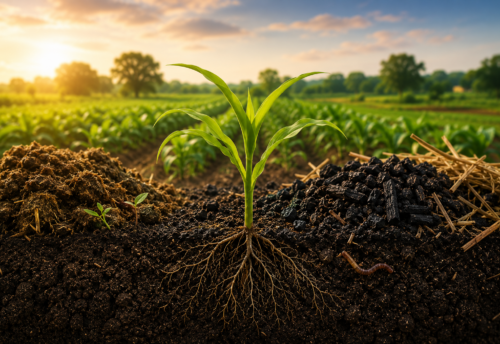
Biochar has a porous, sponge-like structure with a large internal surface area relative to its size. That surface area is what allows it to hold water and nutrients close to plant roots instead of letting them drain away after rain or irrigation, something chemical products does not do at all.
Key Benefits of Biochar for Soil Health
- Increases water-holding capacity, so soil stays moist longer between irrigations
- Improves soil aeration and porosity, supporting stronger root growth
- Provides a stable, long-term habitat for beneficial soil microbes
- Holds nutrients near the root zone, reducing leaching and waste
- Adds organic carbon to soil that does not disappear in a single season
- Helps buffer soil pH swings, especially under temperature stress
- Naturally supports greater disease resistance in crops over time
How Farmers Can Use Biochar
Once the basics of what biochar is are clear, applying it is straightforward and does not require special equipment.
- Choose activated, inoculated biochar rather than raw biochar for faster, more reliable results
- Apply it uniformly to the soil surface, commonly in the range of 75 to 200 kg per acre, adjusted for existing soil condition
- Mix it into the top layer of soil rather than leaving it on the surface
- Irrigate the field after application
- Combine with farm yard manure or compost for compounding benefits
- Reapply regularly, since biochar’s benefits build across multiple seasons rather than peaking in one
A Real-World Example: Engineering Meets Agriculture
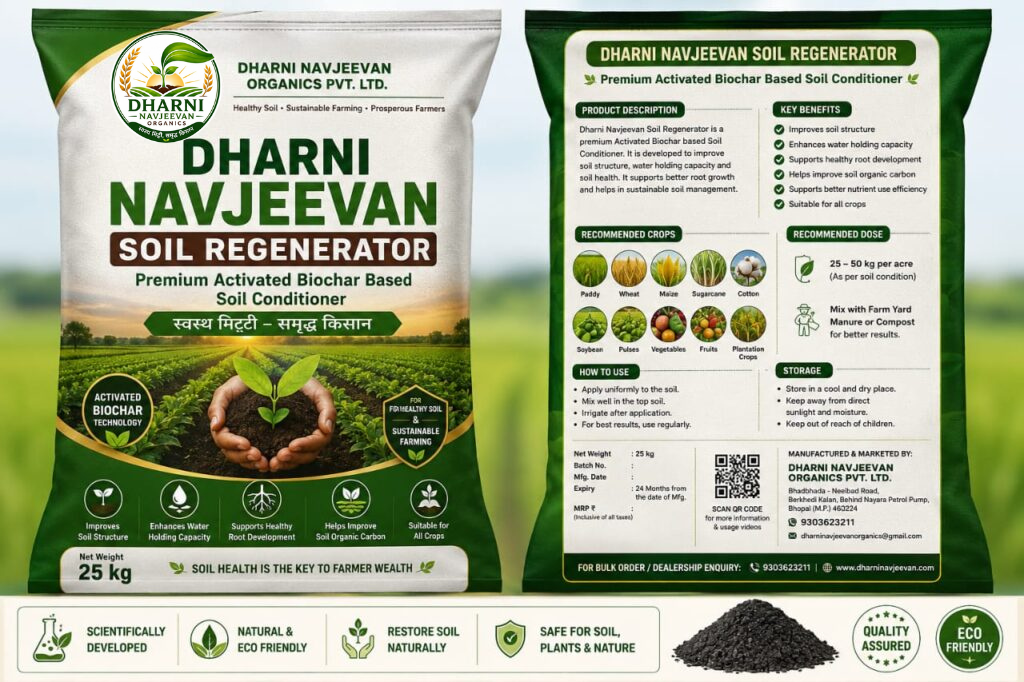
Biochar’s shift from a research topic to a practical farm input has depended heavily on the engineering behind how it is produced. Controlled pyrolysis, activation, and microbial inoculation, done consistently at scale, is what separates a genuinely effective biochar product from a rough, inconsistent one. This is why activated biochar soil conditioners built with real process discipline tend to deliver more predictable results across different farms and soil types than informally produced biochar.
Common Misconceptions About Biochar
One common misunderstanding is that biochar is the same as ordinary charcoal or ash left over from burning crop residue in the field. They are related, but not the same. Charcoal and field-burnt ash are produced without the controlled process, activation, or microbial inoculation that gives true biochar its soil-building properties, and burning residue in the open also wastes the carbon and adds to air pollution rather than capturing it in the soil.
Another misconception is that biochar works instantly, the way a chemical products dose does. In reality, what biochar is best at is long-term structural change: better soil texture and water retention within a season or two, with organic carbon and microbial life continuing to build over several seasons of regular use.
Conclusion: What Is Biochar Worth to Your Farm
What is biochar, in practical terms? It is one of the few soil inputs that becomes more valuable over time rather than less. Where chemical products is spent in a single season, biochar keeps working, holding water, feeding microbes, and rebuilding organic carbon year after year. For farmland that has lost fertility to years of chemical-only inputs, that long-term behavior is exactly what makes biochar worth understanding and worth trying.
FAQ
Q: What is biochar made from?
A: Biochar is made from agricultural biomass, such as crop residue or wood waste, converted into a stable carbon material through controlled heating without oxygen, a process called pyrolysis.
Q: How long does biochar last in soil once applied?
A: Biochar is far more stable than compost or Chemical products and can continue functioning in soil for years rather than breaking down in a single season.
Q: Is biochar the same as charcoal or burnt crop residue?
A: They are related but not the same. True biochar goes through a controlled process and is often activated and inoculated with beneficial microorganisms, which ordinary charcoal or field-burnt ash does not have.
Q: Can biochar be used together with chemical products ?
A: Yes. Many farmers use biochar alongside their existing products program and gradually reduce chemical input as soil health improves.
Q: How much biochar should I apply per acre?
A: For an activated, inoculated biochar soil conditioner, 75 to 200 kg per acre is a common recommended range, depending on the soil’s existing condition.